
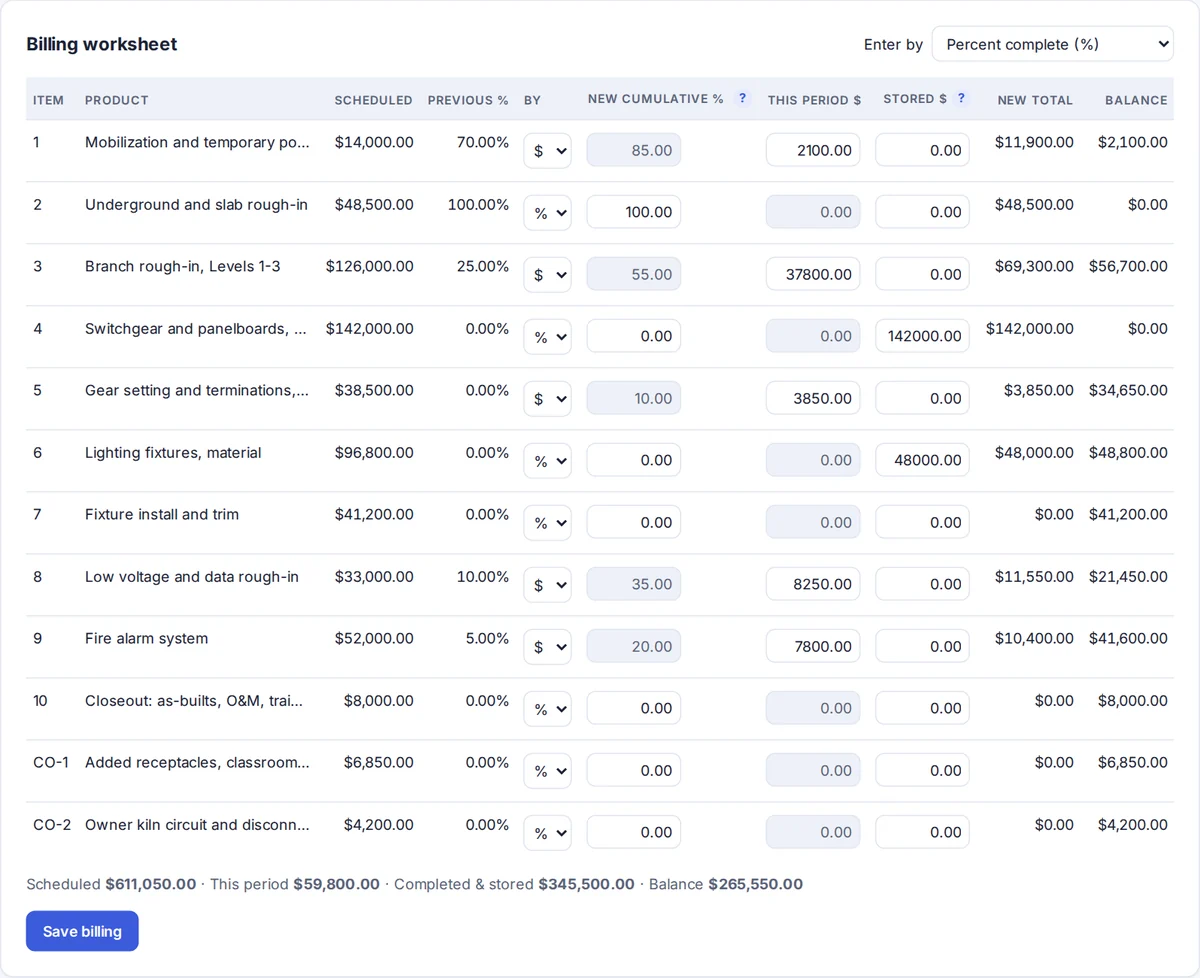
Electrical contractors carry some of the biggest material costs on a commercial job, and a lot of it comes in large, expensive deliveries: switchgear, panelboards, transformers, generators and lighting packages. If those sit on the pay app at zero until they're set and terminated, your cash flow takes the hit.
Bill the gear when it's delivered
When gear or a fixture package arrives, bill it in the Stored column on its line. It counts toward completed and stored to date and retainage just like installed work, and it carries forward to next month automatically. When it's installed, move the amount from stored to work.
Attach the bill of lading, the supplier invoice and photos of the equipment to the same pay app. Everything goes out as one PDF: the signed pay application, the continuation sheet, your lien waiver, then the backup.
Labor and material on separate lines
Many GCs and owners want electrical billed with labor and material split, by building, floor or system. PayAppHub doesn't limit how many lines you have, so a schedule of values like this is no problem:
| # | Description | Scheduled value |
|---|---|---|
| 1 | Mobilization and temporary power | $14,000 |
| 2 | Underground and slab rough-in | $48,500 |
| 3 | Branch rough-in, Levels 1–3 | $126,000 |
| 4 | Switchgear and panelboards, material | $142,000 |
| 5 | Gear setting and terminations, labor | $38,500 |
| 6 | Lighting fixtures, material | $96,800 |
| 7 | Fixture install and trim | $41,200 |
| 8 | Low voltage and data rough-in | $33,000 |
| 9 | Fire alarm system | $52,000 |
| 10 | Closeout: as-builts, O&M manuals, training | $8,000 |
Change orders, every week
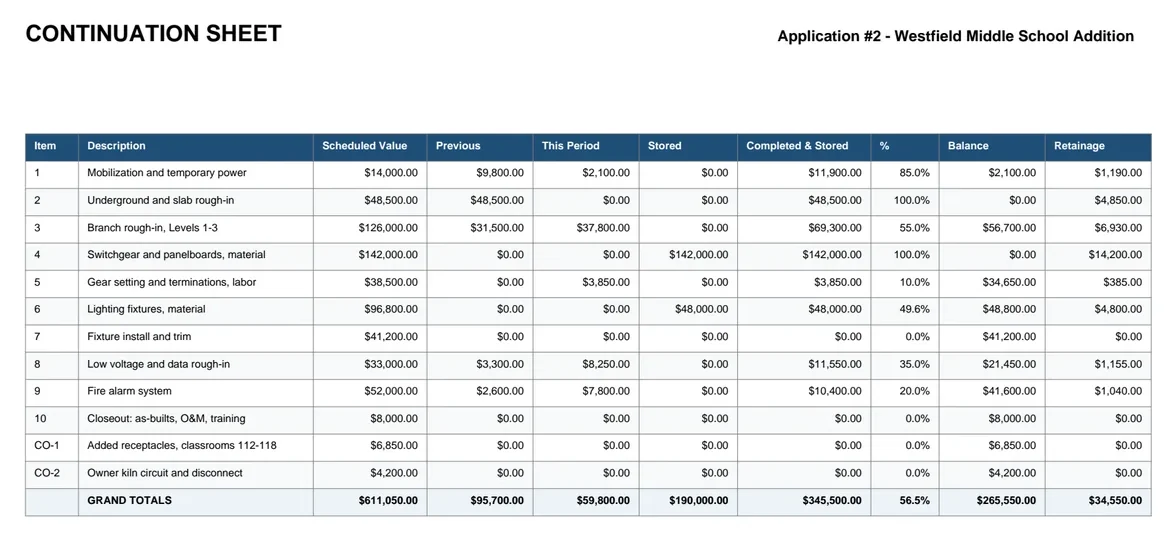
Added receptacles, a relocated panel, a new circuit for owner equipment: electrical change orders come constantly. Add each one when it's approved. It joins the contract total and appears as its own CO line on the schedule of values, ready to bill on the next pay app. Pending change orders stay out of the contract until they're approved, so your contract total always matches what the GC has signed.
Divisions 26, 27 and 28 on one pay app
Electrical subcontracts often cover more than Division 26. Low voltage and data (Division 27) and fire alarm (Division 28, often section 28 46 00) are frequently in the same subcontract but scheduled, inspected and sometimes even billed differently. Owners and lenders like to see them separated, and you'll want to know where you stand on each one.
Keep switchboards and panelboards (26 24 13 and 26 24 16) separate from branch wiring, because the gear is a big-dollar item that bills in one or two large jumps, while branch rough-in moves a little every month. Separating them also makes it obvious to the GC's project manager why your percent complete jumped the month the gear arrived.
Closeout items that hold up your retainage
As-builts, O&M manuals, owner training and the final inspection are often what stands between you and your retainage. Give closeout its own line so it's visible on every pay app, and when the job is done, PayAppHub builds the retainage application with your final lien waiver in one step.
Questions
Can I bill switchgear that's still at the supplier?
Only if your contract and the GC allow off-site stored material, which usually requires a bill of sale, insurance naming the owner, and sometimes an inspection. If they do, bill it in the Stored column and attach that paperwork to the pay app.
Does PayAppHub handle time-and-material tickets?
Bill approved T&M work as a change order with the agreed amount. Attach the signed tickets to the pay app so the backup travels with it.
Can my project managers use it too?
Yes. You can add users to your company, and view-only users are always free.
Is this an official AIA product?
No. PayAppHub produces AIA-style G702 and G703 pages in the layout GCs expect. It isn't affiliated with the American Institute of Architects.