
Pay apps for flooring contractors
Pay applications for flooring contractors
Your material shows up weeks before the slab is ready, half the job is one line called "floor prep," and the GC wants photos of every pallet. PayAppHub is built for that.
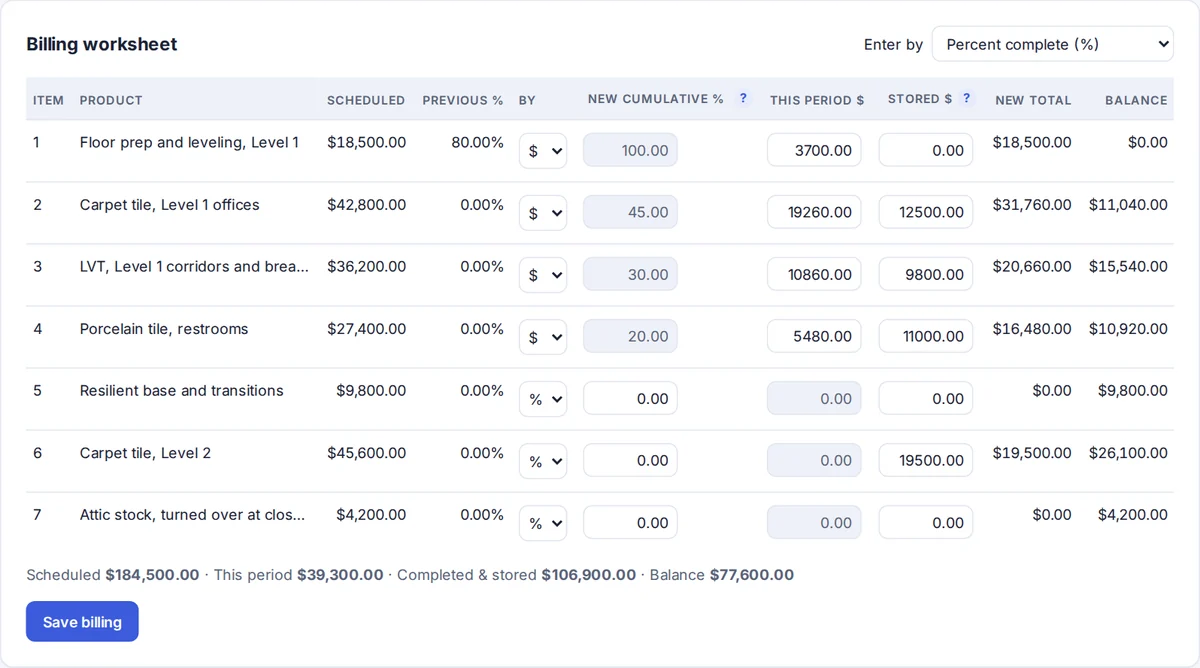
Commercial flooring has a billing problem most trades don't: a big share of the contract is material, and it usually arrives long before you can install it. If you can't bill that material, you're financing the job for the general contractor.
Bill stored material the way GCs want it
When carpet tile, LVT or porcelain lands on site, enter it in the Stored column of that line. It counts toward completed and stored to date and retainage, exactly like installed work, so the G702 math stays right.
GCs almost always want proof. Attach delivery tickets, supplier invoices and photos of the stored pallets to the pay app. PayAppHub labels the photos, reminds you if you bill stored material without any, and puts everything in one PDF behind the signed pay app and your lien waiver.
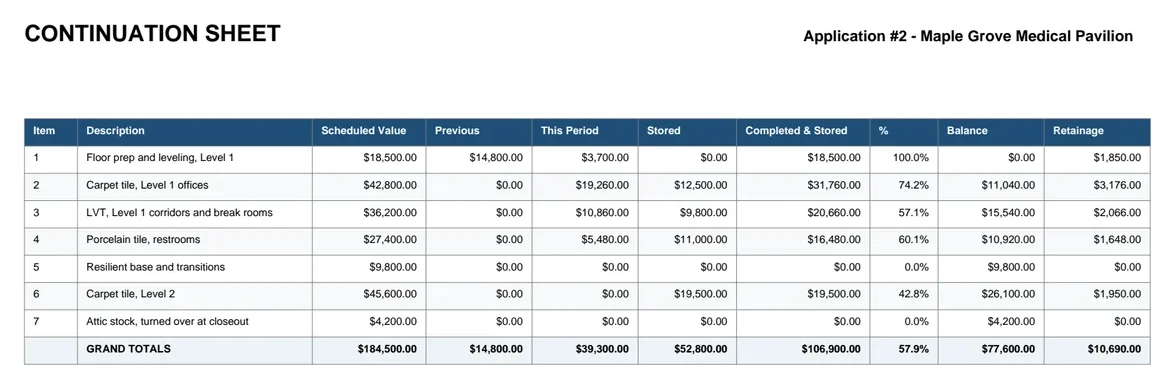
When the material goes down, move the amount from stored to work on the next pay app. The totals carry forward, so nothing gets billed twice.
A schedule of values by area and material
Most flooring subcontracts break down by floor or area and by product, with prep and base as their own lines. A typical one looks like this:
| # | Description | Scheduled value |
|---|---|---|
| 1 | Floor prep and leveling, Level 1 | $18,500 |
| 2 | Carpet tile, Level 1 offices | $42,800 |
| 3 | LVT, Level 1 corridors and break rooms | $36,200 |
| 4 | Porcelain tile, restrooms | $27,400 |
| 5 | Resilient base and transitions | $9,800 |
| 6 | Carpet tile, Level 2 | $45,600 |
| 7 | Attic stock, turned over at closeout | $4,200 |
Set it up once, by typing it or uploading your subcontract and letting PayAppHub read it. Every month after that, you only enter how far each line is.
Floor prep and moisture problems become change orders
Moisture readings that fail, slabs that need mitigation, and leveling well beyond what was bid are where flooring jobs lose money. Add each one as a change order when the GC approves it. It joins the contract total and shows up on the schedule of values as its own line, so you can bill it on the next pay app without rebuilding anything.
What your spec sections mean for billing
Flooring scope is usually spread across several Division 09 sections: tiling (09 30 00), resilient flooring and base (09 65 00), carpet tile (09 68 13), and often a floor preparation or moisture mitigation section. Each one has its own submittals, its own product, and often its own install sequence, which is a good reason to give each its own line on the schedule of values instead of one lump sum.
Watch the moisture requirements in particular. Many specs call for relative humidity testing (ASTM F2170) or calcium chloride testing (ASTM F1869) before installation, with limits set by the flooring manufacturer. When the slab fails, the mitigation work is usually extra, and it should be billed as an approved change order, not absorbed into your carpet line.
Retainage until the last room is done
Flooring is one of the last trades out, so your retainage often sits until the whole building is closed out. PayAppHub tracks retainage on every pay app. When the job is done, one click creates the retainage application, and it attaches your final lien waiver.
Questions
Can I bill flooring material that's stored off site?
Yes, if your contract allows it. Enter it in the Stored column and attach what the GC asks for, usually a bill of sale, an insurance certificate and photos of the material at your warehouse. Off-site storage normally needs the GC's approval before you bill it.
My GC wants labor and material on separate lines. Does that work?
Yes. Your schedule of values can have as many lines as you need, so "Carpet tile, Level 1, material" and "Carpet tile, Level 1, labor" can each be billed on their own.
What if a change order reduces my contract?
Enter it as a negative amount. It lowers the contract total and shows on the schedule of values like any other change order.
Do I need the official AIA forms?
No. PayAppHub produces AIA-style G702 and G703 pages in the familiar layout GCs expect. It isn't affiliated with the American Institute of Architects.