
Pay apps for mechanical contractors
Pay apps for HVAC and mechanical contractors
Rooftop units on a crane day, controls by a sub, balancing at the very end. PayAppHub keeps every piece of a mechanical job on the right line, every month.
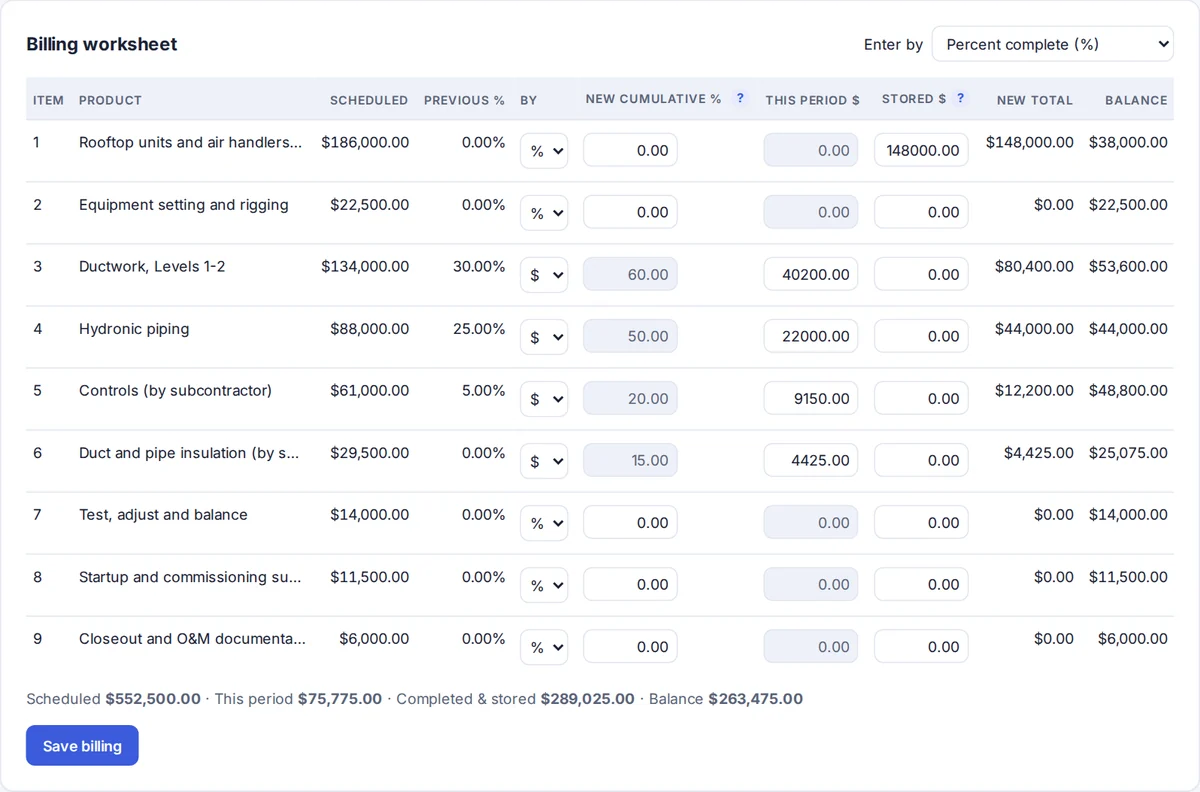
A mechanical subcontract is really several jobs in one: equipment, sheet metal, piping, controls, insulation, testing and balancing, and startup. They bill at different speeds, and some of them are done by your own subcontractors. A good schedule of values keeps them apart, and a good pay app keeps them straight from month to month.
A schedule of values that matches how the job is built
| # | Description | Scheduled value |
|---|---|---|
| 1 | Rooftop units and air handlers, equipment | $186,000 |
| 2 | Equipment setting and rigging | $22,500 |
| 3 | Ductwork, Levels 1–2 | $134,000 |
| 4 | Hydronic piping | $88,000 |
| 5 | Controls (by subcontractor) | $61,000 |
| 6 | Duct and pipe insulation (by subcontractor) | $29,500 |
| 7 | Test, adjust and balance | $14,000 |
| 8 | Startup and commissioning support | $11,500 |
| 9 | Closeout and O&M documentation | $6,000 |
Enter it once, or upload your subcontract and let PayAppHub read the schedule of values for you. Each month you only change the percent complete or the dollars on the lines that moved.
Equipment billed on delivery
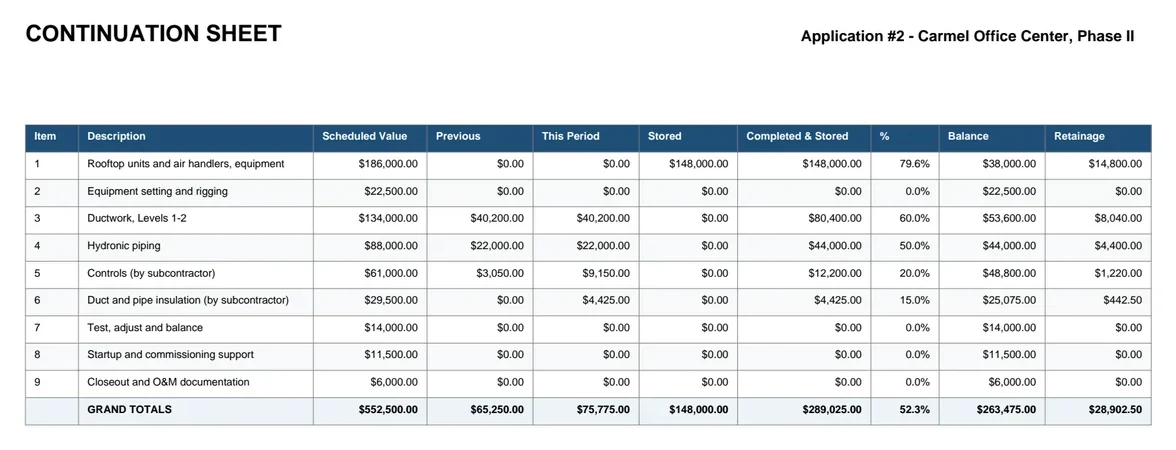
Rooftop units, air handlers, chillers and VRF condensers are some of the most expensive items on any job, and they often sit on site before they're set. Bill them in the Stored column with the delivery ticket and photos attached. They count toward retainage and completed and stored to date like any installed work, and they carry forward until you move them to work.
Your subs' lien waivers go with your pay app
Many GCs won't pay a mechanical contractor until they have lien waivers from the controls, insulation and TAB subcontractors too. Attach those lower-tier waivers to the pay app, and PayAppHub puts them in the package right after your own signed application and lien waiver. One PDF, in the order the GC asked for, instead of five email attachments.
The Division 23 sections behind your lines
A typical mechanical subcontract touches a long list of Division 23 sections: HVAC equipment, ductwork (23 31 00), hydronic piping (23 21 13), instrumentation and controls (23 09 00), insulation (23 07 00), testing, adjusting and balancing (23 05 93), and commissioning (23 08 00). Each has its own submittals and its own completion point.
The ones at the end matter most for billing. Testing and balancing and commissioning can't be finished until the building is nearly done, and specs often require a final TAB report, the commissioning agent's sign-off and O&M manuals before the work counts as complete. Giving each its own line means your pay app shows exactly what's outstanding, and nobody has to guess what "95% complete" means on a $600,000 contract.
Retainage on a long job
Mechanical work runs from underground to final balancing, so retainage builds up over many months. PayAppHub tracks it on every application. When you're done, one click creates the retainage application with your final lien waiver attached.
Questions
Can I split equipment into material and setting?
Yes. Use as many lines as your GC wants. "RTU equipment" and "RTU setting and rigging" can be billed separately.
How do I handle a retainage reduction at 50%?
If your GC agrees to reduce retainage partway through, change the project's retainage percent. The next pay app recalculates retainage on everything billed so far, so check that the amount due matches what the GC expects.
Do I need the official AIA documents?
No. PayAppHub produces AIA-style G702 and G703 pages in the familiar layout. It isn't affiliated with the American Institute of Architects.