
Conditional vs. Unconditional Lien Waivers: Which One to Sign, and When
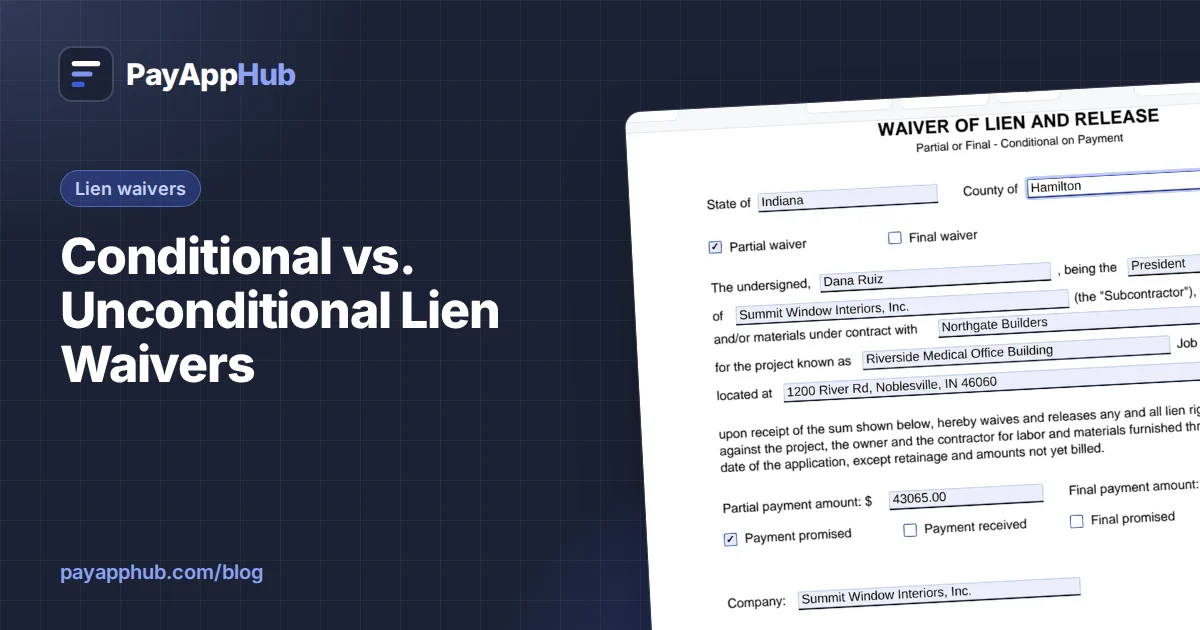
Almost every commercial pay application goes out with a lien waiver. The general contractor needs it to show the owner (and the owner's lender) that the people doing the work are getting paid. For a subcontractor, though, a lien waiver is a legal document that gives up rights, so it's worth knowing exactly what you're signing.
There are four common types, made from two simple questions.
Question 1: Is it conditional or unconditional?
A conditional waiver says: "I give up my lien rights for this amount once I'm actually paid." If the check never comes, or bounces, the waiver doesn't take effect.
An unconditional waiver says: "I give up my lien rights for this amount, period." It takes effect the moment you sign it, whether or not you've been paid.
Question 2: Is it partial (progress) or final?
A partial or progress waiver covers payment through a certain date or for a certain pay application. You keep your rights for work after that date and for retainage that's still being held.
A final waiver covers the whole job. After it, you've generally given up lien rights for the project entirely.
The four combinations
| Covers | Takes effect | |
|---|---|---|
| Conditional progress | Work through a date | When that payment clears |
| Unconditional progress | Work through a date | Immediately |
| Conditional final | The whole job | When the final payment clears |
| Unconditional final | The whole job | Immediately |
The rule that protects you
Send conditional waivers with your pay applications. Sign unconditional waivers only for money that's already in your bank account.
In practice the monthly rhythm looks like this:
- With pay application #3, send a conditional progress waiver for the amount you're requesting.
- When payment #3 clears, send an unconditional progress waiver for that amount, if the GC asks for one. Many GCs ask for it with the next pay app.
- At the end, send a conditional final waiver with your final or retainage release application.
- When the final payment clears, send the unconditional final waiver.
Signing an unconditional waiver before you've been paid is one of the most expensive mistakes a subcontractor can make. If the payment never arrives, you may have already given up the strongest tool you had to collect it.
Read what you're signing
Waiver forms aren't all alike, and GCs often send their own. Before signing, check:
- The amount and the "through" date match the pay application.
- Exceptions. A good form lets you list amounts you're not waiving, such as disputed change orders, retainage or extra work. Use it.
- Extra promises. Some forms slip in statements that you've paid all your suppliers, or that you waive claims beyond lien rights. Know what you're agreeing to.
- Notarization. Some states and GCs require the waiver to be notarized, and some don't. Plan for it if they do, because it can hold up the paperwork.
State rules vary
Several states, including California and Texas, require specific statutory waiver forms with exact wording. In those states a waiver that doesn't follow the statute may not be valid, and some states treat certain forms as unconditional after a set time. Other states let the parties use any form. The rules change, so check your state's current requirements or ask a construction attorney. This article is general information, not legal advice.
Make it routine
The easiest way to avoid waiver mistakes is to make them part of the pay app process, not an afterthought: the right form, with the right amount and date, every time.
PayAppHub fills in your company's lien waiver from each pay application automatically: amount, through date, project and owner. You can edit any field on screen before you send it with the pay application package.