
What Is Retainage, and How Do You Bill the Retainage Release?
Retainage is the part of every payment that the owner or general contractor holds back until the job is finished. On a typical commercial project it's somewhere between 5% and 10% of each pay application. It's meant to protect the owner if work isn't completed or needs to be fixed, and it gives everyone an incentive to finish punch list items and closeout.
For a subcontractor, retainage can add up to a lot of money sitting in someone else's bank account. Understanding how it works, and how to ask for it back, is part of getting paid in full.
How retainage works on each pay application
Every month, retainage is calculated on what you've completed and stored to date, not just on this month's billing. Here's a simple example with 10% retainage on a $100,000 contract:
| Pay app | Completed to date | Retainage held (10%) | Earned less retainage | Paid before | Due this month |
|---|---|---|---|---|---|
| 1 | $30,000 | $3,000 | $27,000 | $0 | $27,000 |
| 2 | $70,000 | $7,000 | $63,000 | $27,000 | $36,000 |
| 3 | $100,000 | $10,000 | $90,000 | $63,000 | $27,000 |
After the third application the work is 100% complete, you've been paid $90,000, and $10,000 is still being held. That's the retainage you'll bill at the end.
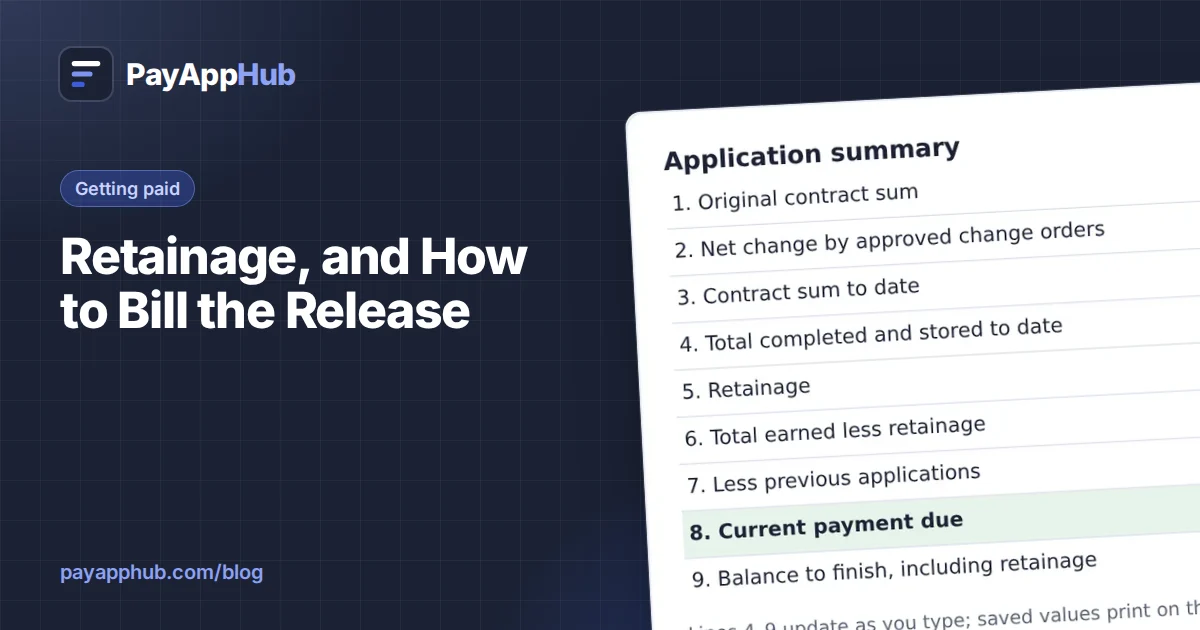
On the G702 this shows up on Line 5 (retainage on completed work and on stored materials), and it flows through to Line 6 (total earned less retainage).
Things to check in your contract
Retainage rules live in your subcontract and in the state's laws, so read both before you send the first pay app.
- The rate. 5% and 10% are common. Some contracts drop the rate once the job reaches 50% complete.
- Stored materials. Some contracts hold retainage on stored materials, some don't, and some hold a different rate.
- When it's released. Common triggers are substantial completion, final completion, owner acceptance, or "when the owner releases retainage to the GC" (often called pay-when-paid).
- What you'll need to submit. Expect a final lien waiver, warranties, O&M manuals, as-builts and closeout documents.
- State law. Many states limit how much retainage can be held, especially on public projects, and set deadlines for releasing it. The rules vary a lot by state, so check yours or ask your attorney.
How to bill the retainage release
When the trigger in your contract is met, you submit a pay application for the retained amount. It usually looks like this:
- Make sure all base work and change orders are billed at 100%. The release application shouldn't include new work.
- Set retainage to zero (or to the reduced amount the contract allows). On the G702, Line 5 drops to $0, so Line 6 equals your full contract sum to date.
- Line 7 is everything you've been paid so far. Line 8, the current payment due, is the retainage being released.
- Attach your closeout documents and the lien waiver the GC asks for. For the final payment that's usually a conditional final waiver, followed by an unconditional final waiver once the check clears.
- Follow up on a schedule. Retainage is the easiest money in a project to forget about. Put a reminder on your calendar for 30 days after substantial completion.
Partial releases
Some projects release retainage in steps, for example half at substantial completion and the rest at final. Others let early trades get their retainage once their scope is accepted, without waiting for the whole building. If your work finishes early in the job, it's worth asking the GC whether an early release is possible. The worst they can say is no.
Keep the numbers straight
The biggest risk with retainage is losing track of it across a long project. Know exactly how much is held on every job, at any time, so nothing slips through when the job closes out.
PayAppHub tracks retainage on every pay application and shows the total held on each project, and its retainage release application zeroes out the held amount without counting it against your monthly pay app allowance.